
How do you determine empirical and molecular formulas? Start with the element amounts, turn them into moles, reduce them to the smallest whole-number ratio, then use molar mass to scale that ratio into the molecular formula. That is the whole trick, and it works for percent composition data or raw mass data. Many students get stuck because they try to guess the formula from the percentages. Don’t do that. If you have percent data, treat the sample as 100 g so each percent becomes grams. If you have grams already, go straight to moles using atomic masses from the periodic table. Then divide every mole value by the smallest one. If you get numbers like 1, 2, and 3, you are done. If you get 1.5 or 1.25, you still have one more step. The empirical formula gives the simplest ratio of atoms. The molecular formula gives the actual number of atoms in one molecule, which means you need the compound’s molar mass too. That second step matters a lot in chemistry I, especially on exam questions where the numbers look close but not exact. Miss one conversion, and the whole answer falls apart. Get the ratio right first. Then scale it.
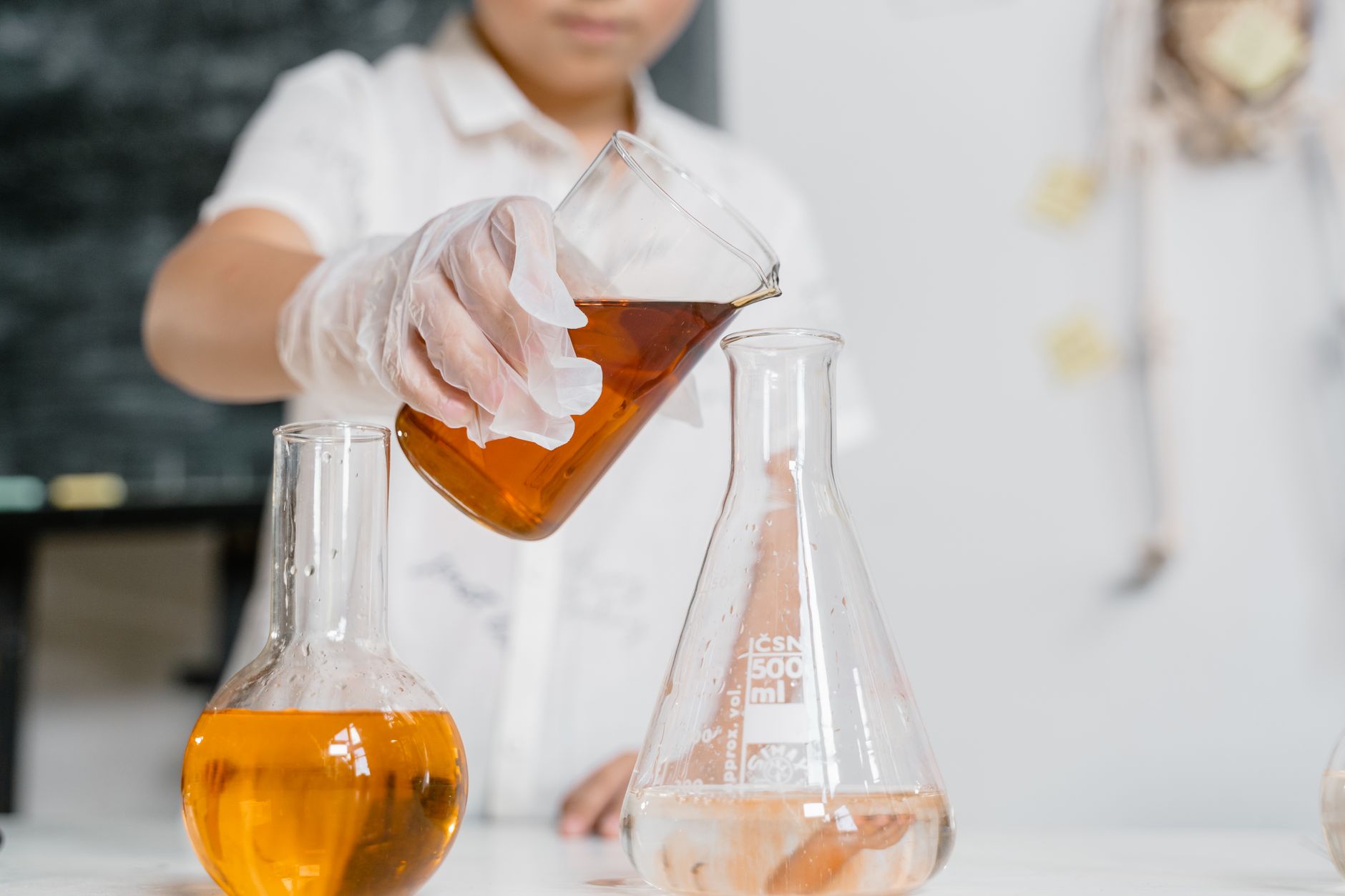
How Do You Find an Empirical Formula?
The empirical formula comes from the simplest mole ratio in a compound, and you can get it from percent composition or from actual gram data. A 100 g sample makes percent problems easy because 24.0% oxygen becomes 24.0 g oxygen, which you can convert right away.
- Start by writing each element’s mass. If the problem gives percentages, assume 100 g so the numbers turn into grams without extra math.
- Convert each gram amount to moles using atomic mass. Carbon uses 12.01 g/mol, oxygen uses 16.00 g/mol, and hydrogen uses 1.008 g/mol.
- Divide every mole value by the smallest one. That step gives the mole ratio, which is the heart of determining empirical formulas.
- Check whether the ratio lands on a clean whole number within a tiny tolerance, like 1.00, 2.00, or 3.00. Small rounding errors happen all the time.
- If a ratio comes out near 1.5, 1.33, or 1.25, multiply every ratio by the same number to clear the fraction. Use 2 for 1.5, 3 for 1.33, and 4 for 1.25.
- Write the formula using the whole numbers you found. A ratio of C 2 H 6 O 2 becomes CH3O if the simplest set reduces that far, but the math decides it, not your gut.
The catch: The smallest mole value sets the scale, not the biggest percentage, and that detail trips up a lot of first attempts.
A clean answer usually shows up fast once the moles line up, but the problem gets ugly if you skip the division step or round too early. In a 25-minute quiz, that mistake can cost the whole problem.
Why Do Mole Ratios Sometimes Need Adjustment?
Mole ratios sometimes land on fractions because the original data came from measurements, and measurements carry tiny error. A ratio of 1.50 does not mean “close enough to 1”; it usually means multiply every value by 2 so you get 3:2 instead of 1.5:1.
A ratio of 1.33 usually points to 4:3, since 1.33 × 3 gives about 4.00. A ratio of 1.25 usually points to 5:4, and 1.20 often points to 6:5. Those patterns show up a lot in chemistry I problems, especially on exams with 2–3 significant figures. Rounding 1.33 to 1.3 before you think can wreck the whole formula.
Reality check: The formula should come from the ratio, not from wishful rounding, and that is a hard rule students learn after one bad quiz.
The logic stays simple: you want the smallest whole-number set that matches the mole counts. If the ratio set is 1.00, 1.50, and 1.00, multiply by 2 to get 2, 3, and 2. If it is 1.00, 1.25, and 1.50, multiply by 4 to get 4, 5, and 6. That is why you reduce first and adjust second. A neat ratio beats a lucky guess every time.
A weak spot in this topic is impatience. Students often stop at the first decimal they see, but a 0.02 difference can mean the real ratio wants a multiplier of 2, 3, or 4. The math looks fussy, yet the payoff is a formula that actually fits the data.
Learn Chemistry Online for College Credit
This is one topic inside the full Chemistry course on UPI Study — a self-paced, online class that earns real college credit. Credits are ACE and NCCRS evaluated and transfer to partner colleges across the US and Canada. Courses start at $250 with no deadlines and lifetime access.
Browse Chemistry Course →How Do You Use Molar Mass To Get Molecular Formula?
The molecular formula comes from comparing the empirical formula mass to the compound’s molar mass, then multiplying every subscript by the same whole number. If the empirical formula mass is 30 g/mol and the molar mass is 60 g/mol, the multiplier is 2, so every atom count doubles.
First find the empirical formula mass by adding atomic masses. Then divide the known molar mass by that number. A result of 1 means the empirical and molecular formulas match, like CH2O when the molar mass also lands near 30 g/mol. A result of 2 means double every subscript. A result of 3 means triple every subscript.
Bottom line: You never change just one subscript, because the molecule must keep the same atom ratio that the empirical formula gave you.
This step matters because two compounds can share the same empirical formula and still have different molecular formulas. Glucose and formaldehyde both connect to simple carbon-hydrogen-oxygen ratios, but their molar masses tell different stories. That difference shows why molar mass matters so much in determining empirical and molecular formulas. Skip it, and you only have a shortcut, not a real answer.
A decent sanity check helps here. If your multiplier comes out to 1.97 or 3.02, you probably have a rounding issue in the empirical mass or the given molar mass. If it comes out to 1.5, your numbers do not match a molecular formula yet, because the multiplier must be a whole number. That is a problem, not a final answer.
Which Worked Examples Show The Full Process?
A Chemistry I course at a community college in Ohio once used a 42 g/mol sample as a quiz problem, and the class had to move fast because the lab period lasted only 50 minutes. That kind of setup is real, not fake practice, and it shows why you need a clean process for percent composition and molar mass. One student can solve it in 4 steps. Another can lose half the points by rounding 1.33 to 1.3. The math is not hard, but the order matters a lot.
- Example 1: 40.0% C, 6.7% H, 53.3% O becomes 40 g C, 6.7 g H, 53.3 g O in a 100 g sample.
- Convert to moles: about 3.33 mol C, 6.64 mol H, and 3.33 mol O, then divide by 3.33.
- The ratio is 1:2:1, so the empirical formula is CH2O.
- If the molar mass is 180 g/mol, the multiplier is 6, so the molecular formula becomes C6H12O6.
- Example 2: A 42 g/mol compound with empirical formula CH2 has empirical mass 14 g/mol, so the multiplier is 3.
Chemistry I course work often uses exactly this kind of setup, because one percent table can hide a lot of real chemistry in a small space.
- Example 3: 24.0 g C, 4.0 g H, 32.0 g O gives 2.00 mol C, 3.97 mol H, and 2.00 mol O.
- Divide by 2.00 and you get 1:2:1 again, which is CH2O.
- If a formula mass problem gives 60 g/mol, the molecular formula is C2H4O2.
Chemistry I practice gets easier when you treat every problem the same way, because the pattern repeats even when the numbers change.
- Example 4: A 1.5 ratio in the raw mole data means multiply everything by 2.
- That turns 1:1.5 into 2:3, which can produce formulas like C2H3 or N2O3 depending on the elements.
- One bad shortcut here can turn a correct answer into a nonsense formula.
What Mistakes Do Students Make Most?
Many errors come from rushing through a problem that really needs 3 careful moves: convert, divide, and compare. On a 10-question quiz, one skipped step can sink 2 or 3 full problems, which hurts fast.
- Do not use percentages as subscripts. 40% oxygen does not mean O40; it means 40 g in a 100 g sample.
- Do not round before you compare every mole value. A ratio of 1.33 often means 4:3, not 1:1.
- Do not mix up empirical mass with molecular mass. CH2O has an empirical mass near 30 g/mol, while the real compound might weigh 180 g/mol.
- Do not multiply only one subscript. If the multiplier is 3, every atom count gets tripled.
- Check for impossible formulas. If your answer gives a fractional atom count or a molar mass that misses by 10%, stop and rework it.
- Do not forget to convert percent to grams first. That one mistake shows up in about half the bad answers I see in intro chemistry.
Frequently Asked Questions about Empirical And Molecular Formulas
You find the empirical formula by assuming 100 g, converting each percent to grams, changing grams to moles, then dividing by the smallest mole value to get a whole-number ratio. If the ratio lands near 1.5 or 2.5, multiply all subscripts by 2 or 3 instead of rounding early.
Most students expect the molecular formula to be different from the empirical formula, but sometimes they're the same, like H2O or CO2. The molecular formula only changes when the molar mass is a whole-number multiple of the empirical formula mass.
Start by turning every mass in grams into moles using atomic masses from the periodic table, like 12.01 for carbon or 16.00 for oxygen. Then divide every mole value by the smallest one and simplify to the nearest whole-number ratio.
If you round too soon or skip the mole ratio step, your molecular formula can come out wrong by a factor of 2, 3, or 4. That mistake can cost full credit on a chemistry I exam, because one bad subscript changes the whole compound.
Most students try to guess the formula from the percent numbers, but that usually fails. What works is a clean 3-step path: assume 100 g, convert to moles, then reduce to the smallest ratio and use molar mass to scale it.
This method applies to anyone in chemistry I, a chemistry I course, or an online course that covers formulas, and it also fits college credit work with ACE NCCRS credit or transferable credit. It doesn't apply when you only have a name like 'sodium chloride' and no composition or mass data.
The most common wrong assumption is that the empirical formula and molecular formula always match. They match only when the molar mass equals the empirical formula mass; glucose, for instance, has empirical CH2O and molecular C6H12O6, a 180 g/mol compound with a 30 g/mol empirical unit.
$0 errors still show up when you forget to use the full sample mass or when you mix up percent and grams, so always check units first. In a 36.0 g sample that's 40.0% carbon, you treat carbon as 14.4 g before you convert to moles.
You divide the compound's molar mass by the empirical formula mass to get a whole number, then multiply every subscript by that number. If the empirical formula mass is 30 g/mol and the molar mass is 180 g/mol, the multiplier is 6, so CH2O becomes C6H12O6.
A sample with 52.2% C, 13.0% H, and 34.8% O gives 52.2 g C, 13.0 g H, and 34.8 g O if you assume 100 g, then about 4.35, 12.9, and 2.18 moles, which reduces to CH3O. If the molar mass is 62 g/mol and the empirical mass is 31 g/mol, the molecular formula is C2H6O2.
You avoid the biggest mistakes by not rounding mole ratios too early, not skipping the 100 g assumption for percent data, and not mixing up empirical mass with molar mass. Keep the periodic table close, and check whether your final subscripts give the same atom count ratio as your original data.
Final Thoughts on Empirical And Molecular Formulas
The clean way to handle empirical and molecular formulas never changes: turn mass or percent into moles, reduce to the smallest whole-number ratio, then use molar mass to scale up when you need the molecular formula. That process sounds basic, and it is. Basic does not mean easy under pressure. Most students lose points in the same places. They round too early. They forget the 100 g shortcut for percent problems. They treat a 1.33 ratio like a final answer instead of a sign to multiply by 3. Once you stop making those moves, the problems get a lot friendlier. A good habit helps more than raw memory. Write the units next to every number. Cross out grams after you convert to moles. Circle the smallest mole value before you divide. Then check whether your multiplier gives a whole number like 2, 3, or 4. If it does, you are usually in solid shape. That kind of process works on quizzes, lab reports, and placement-style questions, because chemistry rewards order more than speed. Keep one scratch sheet for conversions and one line for the final ratio. Then practice with 3 or 4 samples until the pattern feels automatic.
How UPI Study credits actually work
Ready to Earn College Credit?
ACE & NCCRS approved · Self-paced · Transfer to colleges · $250/course or $99/month