
Neural networks in artificial intelligence are math models that copy one part of the brain’s style, not its biology. They take data in, push it through layers of simple units, and turn that into a prediction, a label, or a score. That sounds abstract, so here’s the plain version: a network looks for patterns, learns from examples, and gets better at tasks like classifying photos, spotting spam, or predicting the next word in a sentence. The basic setup is small but powerful. An input layer receives data, hidden layers mix and reshape it, and an output layer gives the result. Each connection carries a weight, and those weights tell the model which signals matter most. An activation function then decides how strongly a neuron fires. That mix lets the model handle messy data, where a rule-based system would fall apart after 10 minutes. People often talk about neural networks like magic. They are not magic. They are trained math with a lot of adjustable knobs, and they need lots of examples to work well. A network might use 3 layers or 300 layers, depending on the job. Image systems, speech tools, and language models all use the same core idea, just at very different scales. Once you see the flow from input to output, the whole thing gets less mysterious and a lot more useful.
What Are Neural Networks in AI?
A neural network is a machine learning model that learns patterns from data, not a literal brain, and it can sort images, predict text, or classify spam with surprising speed. The idea comes from the brain’s connected cells, but the model uses numbers, weights, and matrix math, not thoughts or feelings.
A simple network might learn from 10,000 labeled photos and get better each time it sees another face, car, or dog. That is why people use neural networks for image recognition, speech tools, fraud checks, and language models. They do well when the input has many tiny signals that matter together, like the 256 pixels around an eye or the 20 words in a sentence.
The catch: Neural networks do not “understand” like a person does, and that gap matters when a model sees a weird case it never trained on. Still, they beat hand-built rules on lots of tasks because they can learn from examples instead of waiting for a programmer to write every rule.
A network learns a mapping: input goes in, output comes out. If you feed it 5,000 emails and label 1,200 as spam, the model can learn which word patterns, sender habits, and link styles point toward junk mail. That same idea powers face unlock, translation, and recommendation systems, though each one uses different training data and different network sizes.
How Do Neural Network Layers Work?
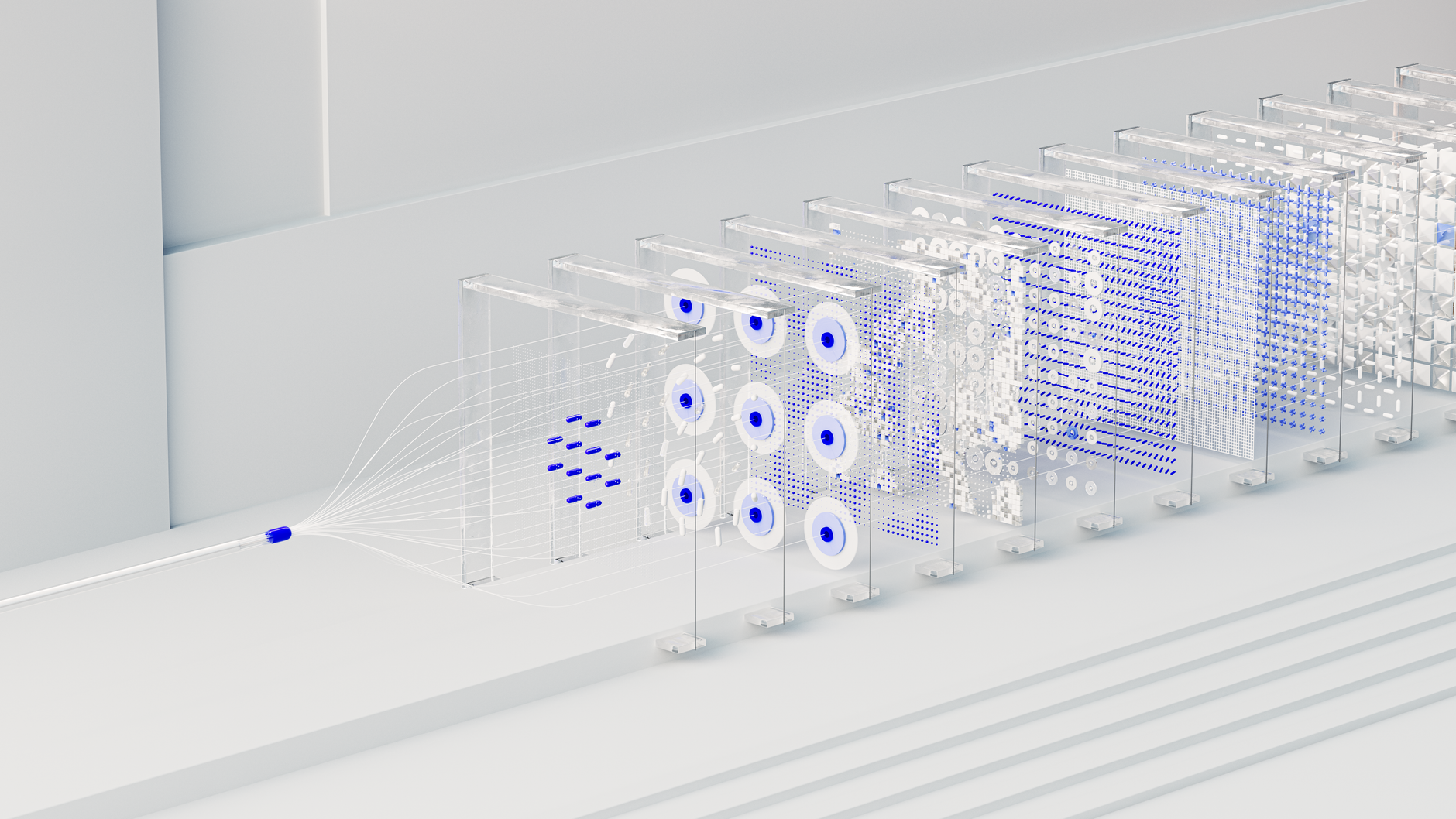
A neural network moves data through an input layer, one or more hidden layers, and an output layer, and each layer changes the information a little before passing it on. The input layer takes the raw numbers, like 784 pixels from a 28×28 image or 300 word features from text, and the next layers start mixing them.
Hidden layers do the heavy lifting. One layer might spot edges, another might combine edges into shapes, and a third might combine shapes into faces or letters. That stacked process matters because a 1-layer model can only draw simple patterns, while a 10-layer model can build much richer ones. Deep networks earned that name for a reason.
Reality check: More layers can help, but 50 layers of nonsense still give you nonsense if the data stays weak or noisy. Depth gives the model more room to learn, yet it also makes training slower and harder to tune.
Information flows forward one step at a time. The model takes inputs, multiplies them by weights, adds up the results, and sends the signal on. In a network with 3 hidden layers, each layer acts like a filter that keeps some details and drops others. That is why the same architecture can sort X-rays, read handwriting, or flag a bad loan application.
How Do Neurons, Weights, and Activations Work?
A single artificial neuron takes a few inputs, multiplies each one by a weight, adds them up with a bias, and sends the total through an activation function. That sounds small, but a network with 1,000 neurons can stack these little decisions into something that handles images, text, or tabular data. In a model with 3 hidden layers, each neuron acts like a tiny gate, and the gate only opens when the math says the signal matters.
Worth knowing: Weights control importance, bias shifts the starting point, and activation decides whether the neuron fires hard, weakly, or not at all. That simple trio lets the model draw curves and bends instead of only straight lines.
- Big weights push a signal harder; a weight of 0.9 matters more than 0.1.
- ReLU keeps positive values and drops negatives, so it helps large models train faster.
- Sigmoid squeezes outputs into 0 to 1, which fits probability-style tasks.
- Bias helps a neuron fire even when inputs stay near 0, which prevents flat behavior.
- Bottom line: The same neuron logic works in a 2-layer toy model and in systems with millions of parameters.
A lot of students expect a neuron to act like a mini-brain cell. That image helps for about 30 seconds, then it starts to mislead. The better mental model is a calculator with a memory of past examples, because the math decides everything.
Learn Artificial Intelligence Online for College Credit
This is one topic inside the full Artificial Intelligence course on UPI Study — a self-paced, online class that earns real college credit. Credits are ACE and NCCRS evaluated and transfer to partner colleges across the US and Canada. Courses start at $250 with no deadlines and lifetime access.
Explore on UPI Study →How Do Neural Networks Learn From Data?
Training gives a neural network its skill. The model sees data, makes a guess, checks how wrong it was, and changes its weights a little bit at a time. After 10, 20, or 100 passes through the data, those small changes can turn shaky guesses into solid predictions.
- The network feeds input forward and makes a prediction, such as “cat” or “dog” from a 224×224 image.
- It compares that guess with the real answer and measures error with a loss function, which might drop from 1.8 to 0.4 over time.
- Backpropagation sends the error backward through the layers so the model can see which weights caused the miss.
- An optimizer updates the weights, often in tiny steps after each batch of 32 or 64 examples.
- The model repeats the loop for many epochs, and 5 good epochs can beat 50 sloppy ones if the data stays clean.
- Overfitting can appear when the network memorizes 100% of training data but fails on new examples, which makes test accuracy sink fast.
The catch: More data usually helps because the model sees more patterns, but raw size alone does not save a bad setup. A network trained on 1 million examples with poor labels can still learn the wrong lesson.
Why Are Neural Networks So Useful?
Neural networks work well because they handle messy patterns that do not fit neat rules, and that gives them an edge in vision, speech, recommendations, and text. A phone camera app can spot a face in under 1 second, a speech model can turn sound into words, and a shopping site can rank 50 products based on past clicks.
They also handle prediction jobs that change over time. A network can study 12 months of sales data, weather records, or app usage logs and spot trends that a fixed formula misses. That flexibility has a price, though. Bigger models need more data, more computing power, and more time, and a system with 100 million parameters can be expensive to train and hard to explain.
Reality check: Neural networks shine when the data is rich and messy, but they struggle when the sample size is tiny or the labels are sloppy. That tradeoff is the whole game: more power, more cost, more moving parts.
People use them because they beat older methods on hard tasks, not because they look elegant on a slide. If the job involves thousands of tiny signals that interact in strange ways, a neural network often makes the best shot at a useful answer.
Should You Study Neural Networks Online?
A solid online start usually takes 5 to 10 hours a week, and that pace fits a 6- to 12-week course without turning your calendar into rubble. Look for lessons that explain layers, weights, activation functions, and training steps with real examples, not just glossy promises.
- Pick a course that explains the full loop: input, prediction, loss, backpropagation, and update.
- Look for 6 to 12 weeks of work, or a clear hour count like 20 to 40 total hours.
- Good courses show ReLU, sigmoid, and softmax with code or diagrams, not vague theory.
- If you want college credit, check for ACE or NCCRS recognition and a transcript path.
- AI course online options matter when you want transferable credit, not just a certificate.
- Worth knowing: A course with 70% projects and 30% quizzes often teaches more than a lecture-only class.
- Choose a class that includes Python or another coding tool, because neural nets make more sense when you build one.
A weak course can talk about AI for 3 hours and still leave you guessing how training works. That is a bad trade. A better course shows the math, the code, and the failure cases side by side.
Frequently Asked Questions about Neural Networks
Most students think neural networks are just a fancy label for AI, but what actually works is learning the parts: layers, neurons, weights, and activation functions. A neural network in AI is a model that passes data through 2 or more layers to spot patterns and make predictions.
If you mix them up, you'll expect a fixed rule system to learn from data, and it won't. Neural networks change weights during training, so they can improve on tasks like image tagging or spam detection after seeing thousands or millions of examples.
Neural networks learn by comparing their guesses with the right answers and then changing weights to make fewer mistakes. Backpropagation helps the model adjust millions of weights across 3 or more layers, and activation functions decide which signals move forward.
This applies to anyone studying AI, machine learning, or data science, and it doesn't apply to you if you only want a quick app demo with no theory. If you're taking an introduction to artificial intelligence course, you'll see neural networks as a core topic, not a side note.
Start with a simple online course that explains neurons, layers, and weights before you touch code. If you want college credit, look for an introduction to artificial intelligence course that lists ACE NCCRS credit and transferable credit on the course page.
What surprises most students is that neural networks don't think like brains, even though they copy the idea of connected cells. They're math systems that use numbers, usually in matrices, and they can train on 10,000 or 10 million examples without 'understanding' them the way people do.
A small network can work with 2 or 3 layers, while deep learning models can use dozens or even hundreds. A simple image classifier might train on 1,000 labeled photos, but stronger models often need far more data and longer training time.
The most common wrong assumption is that activation functions just add extra math with no real job. They control whether a neuron fires, and functions like ReLU or sigmoid help the model handle non-linear patterns that straight line formulas miss.
Yes, neural networks often beat simpler algorithms on messy pattern tasks like speech, handwriting, and image recognition. They learn hidden links across many inputs, which helps when the answer depends on 50 pixels, 20 words, or several past data points.
Weights decide how much each input matters, and they change every time the model trains on new data. A network with 1,000 weights can give one feature huge influence and another almost none, which is how it learns to rank signals.
Neural networks power modern machine learning because they handle large, messy data sets and learn patterns without hand-built rules. You see them in recommendation systems, translation tools, fraud checks, and models trained on text, audio, or images.
You can study neural networks in an introduction to artificial intelligence course online and earn college credit through ACE NCCRS credit when the program lists it. That setup helps you study online and build transferable credit while you learn layers, neurons, and training.
Final Thoughts on Neural Networks
Neural networks sound big, but the core idea stays small: data comes in, numbers change inside layers, and the model learns which patterns matter. Once you see that flow, image recognition, speech tools, and text prediction stop looking like black magic. The real trick sits in the training process. A network does not wake up smart. It gets smart through examples, error checks, and repeated weight updates, and that is why data quality matters so much. A model with 10,000 clean examples often beats a model with 1 million sloppy ones. That surprises people, but it should not. You also need to keep the tradeoffs in view. Bigger networks can spot finer patterns, but they ask for more computing power, more data, and more care. Smaller models can still work well when the job stays narrow. That balance explains why neural networks show up everywhere from phone cameras to translation tools. If you want to understand modern AI, start with the parts that repeat: input, layers, weights, activation, loss, and training. Those pieces show up in almost every serious machine learning system, even when the model name changes. The next smart move is to build or study one small network yourself and watch the numbers move.
How UPI Study credits actually work
Ready to Earn College Credit?
ACE & NCCRS approved · Self-paced · Transfer to colleges · $250/course or $99/month