
A calorimetry lab measures heat transferred during a physical or chemical process by observing temperature changes. For example, you might place a heated metal sample in water and use the water’s temperature rise to estimate the metal’s specific heat. The key is to track where the heat goes and make your assumptions clear.
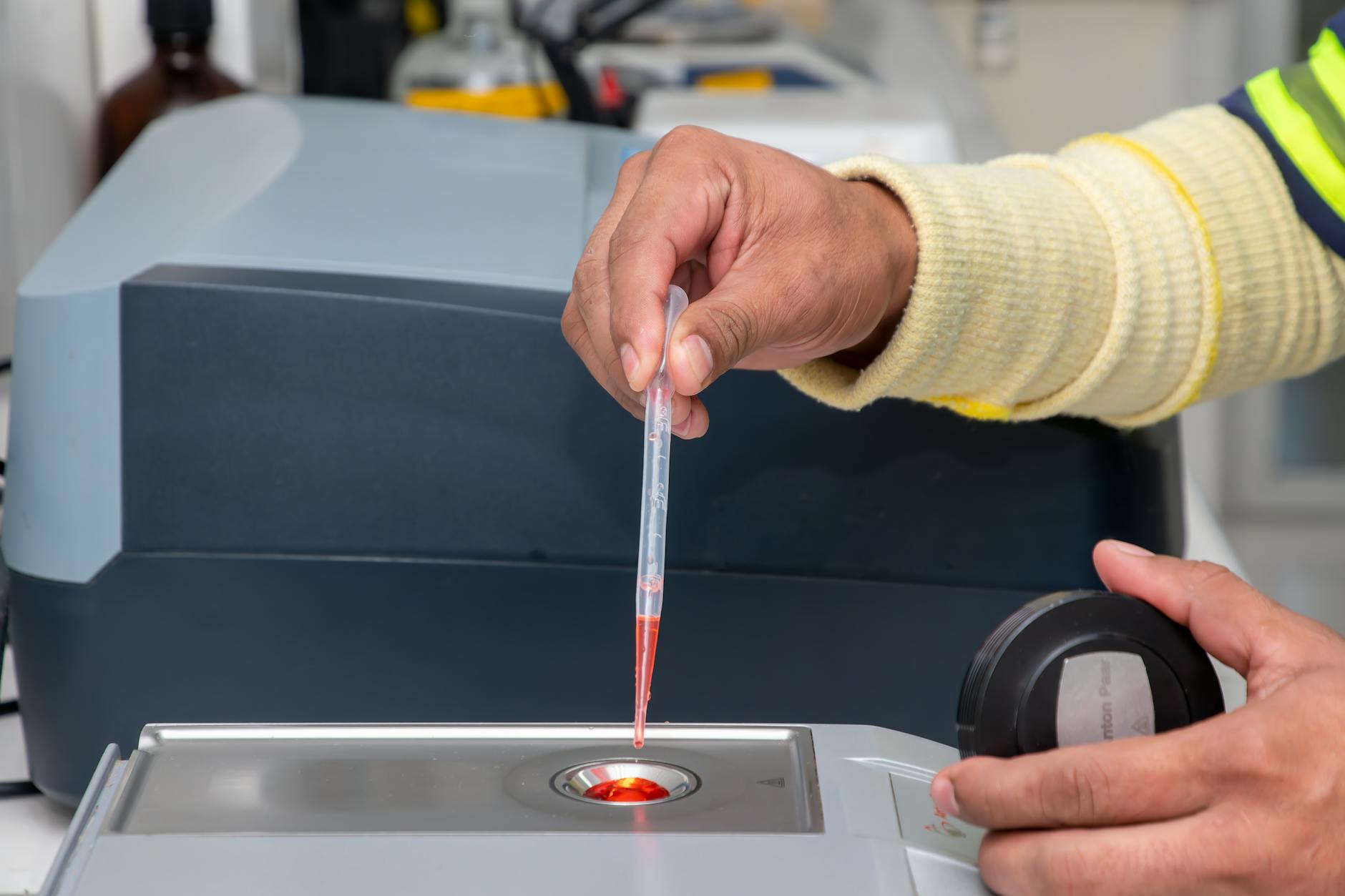
What is chemistry lab work?
Chemistry lab work involves observing substances, making measurements and using evidence to answer questions. In calorimetry, the question is often how much heat a process releases or absorbs.
In a specific heat experiment, a warm sample is placed in cooler water. Energy moves from the sample to the water until they reach a shared final temperature. If heat exchange with the cup and surroundings is negligible, the heat gained by the water is approximately equal to the heat lost by the sample: q_water ≈ −q_sample.
A process can also change the temperature of a solution. For example, dissolving a substance can warm or cool water; the solution’s temperature change helps estimate the heat associated with dissolving.
What is chemistry lab equipment?
A coffee cup calorimeter is typically an insulated cup with a lid and a temperature probe or thermometer. It limits heat exchange with the surroundings but does not eliminate it. The setup is commonly used to study processes at approximately constant pressure.
You may also use a balance to measure mass, a graduated cylinder to measure liquid volume, and a stirring device to help the mixture reach a uniform temperature. Record the precision of each measurement. The chemistry lab equipment guide explains more common tools and their uses.
Follow your lab’s safety directions, wear the required protective equipment, and let an instructor or lab manual guide any heating and chemical handling.
Which colleges have matched Chemistry Lab? 2 colleges confirm UPI Study's Chemistry Lab (CHEM 111L, 1 credits), according to their equivalency pages on UPI Study. Here they are, with the course it counts as at each:
| College | Course it counts as | Credits | How it counts |
|---|---|---|---|
| Thomas Edison State University | CHE-1280 General Chemistry I Lab | 1 | Transfers |
| University of the People | General Elective (UoPeople) | 1 | Transfers (Elective) |
See Chemistry Lab on UPI Study →
ACE and NCCRS have over 2,100 cooperating colleges that will consider accepting credits; the final decision is with the universities. Each college confirms the course when it evaluates your transcript.
How do you work in a chemistry lab?
A typical specific heat procedure compares a heated sample with cooler water. Follow the assigned procedure rather than substituting materials or temperatures.
- Measure the mass of the sample and the mass of water in the calorimeter.
- Record the initial temperature of the water and the sample.
- Place the sample in the water, cover the calorimeter and gently stir as directed.
- Record the final equilibrium temperature and calculate ΔT = T_final − T_initial for each material.
- Calculate heat gained by the water and use it to estimate the sample’s specific heat.
For example, suppose 100.0 g of water warms from 20.0°C to 25.0°C. Using water’s specific heat of 4.184 J/(g·°C), q_water = (100.0 g)(4.184 J/(g·°C))(5.0°C) = 2,092 J. The water gained heat, so its q is positive.
If a 50.0 g sample cools from 125.0°C to 25.0°C, its ΔT is −100.0°C. Assuming the water gains all the heat the sample loses, q_sample ≈ −2,092 J. Rearranging q = mcΔT gives c_sample ≈ (−2,092 J)/[(50.0 g)(−100.0°C)] = 0.4184 J/(g·°C). Actual results may differ because the cup and surroundings also exchange heat. For more on recording measurements, see measurement in chemistry.
The Complete Resource for Calorimetry
UPI Study has a full resource page built specifically for calorimetry — covering which courses count and how to get started at $250 per course with no deadlines. Your college decides how credits transfer.
See the Chemistry Lab course →How do you write a chemistry lab report?
A calorimetry report should show what you measured, how you calculated heat and what limits your conclusion. Use the format and rubric assigned by your instructor.
- State the experiment’s purpose and briefly describe the procedure.
- Present masses and initial and final temperatures with units.
- Show ΔT and q calculations, including signs and the assumed specific heat of water.
- Report the result with appropriate units and precision.
- Discuss uncertainty, such as heat absorbed by the cup, heat lost to air or a sample cooling during transfer.
Explain how a source of error might affect the result rather than simply listing it. The guide to writing a chemistry lab report offers a fuller outline.
What does chemistry lab include?
The UPI Study Chemistry Lab course includes a virtual calorimetry activity covering calcium chloride, ammonium nitrate, heat calculations and heat loss. Its full course outline is shown below.
| # | Chapter | Lessons | Hours |
|---|---|---|---|
| Lab 1 | Mass, Volume, and Density | Reading: Lab-01_Student-Handout_and_Rubric.docx (student directions); Virtual lab sequence: Overview → Pre-Lab → Part A · Mass → Part B · Dimensions → Part C · Displacement → Calculations → Identify Unknown → Post-Lab → Lab Report; Assignment: complete the simulation and submit the auto-compiled lab report, graded against the instructor rubric (final page of the same document) | 9 |
| Lab 2 | Avogadro's Number and the Mole | Reading: Lab-02_Student-Handout_and_Rubric.docx (student directions); Virtual lab sequence: Overview → Pre-Lab → Part A · Counting → Part B · Molar Mass → Part C · Samples → Part D · Water → Calculations → Post-Lab → Lab Report; Assignment: complete the simulation and submit the auto-compiled lab report, graded against the instructor rubric (final page of the same document) | 9 |
| Lab 3 | Empirical Formula of Zinc Chloride | Reading: Lab-03_Student-Handout_and_Rubric.docx (student directions); Virtual lab sequence: Overview → Pre-Lab → Part A · Weigh Zinc → Part B · Reaction → Part C · Evaporate → Empirical Formula → Definite Proportions → Post-Lab → Lab Report; Assignment: complete the simulation and submit the auto-compiled lab report, graded against the instructor rubric (final page of the same document) | 9 |
| Lab 4 | Calorimetry | Reading: Lab-04_Student-Handout_and_Rubric.docx (student directions); Virtual lab sequence: Overview → Pre-Lab → Part A · Setup → Part B · CaCl₂ → Part C · NH₄NO₃ → Heat Calculations → ΔH & Heat Loss → Post-Lab → Lab Report; Assignment: complete the simulation and submit the auto-compiled lab report, graded against the instructor rubric (final page of the same document) | 9 |
| Lab 5 | Chromatography | Reading: Lab-05_Student-Handout_and_Rubric.docx (student directions); Virtual lab sequence: Overview → Pre-Lab → Part A · Develop → Part B · Known Rf → Part C · Unknown → Identify → Polarity → Post-Lab → Lab Report; Assignment: complete the simulation and submit the auto-compiled lab report, graded against the instructor rubric (final page of the same document) | 9 |
| Lab 6 | Titration Curves Using a pH Probe | Reading: Lab-06_Student-Handout_and_Rubric.docx (student directions); Virtual lab sequence: Overview → Pre-Lab → Part A · HCl → Part B · CH₃COOH → Part C · pKa → Concentrations → Interpretation → Post-Lab → Lab Report; Assignment: complete the simulation and submit the auto-compiled lab report, graded against the instructor rubric (final page of the same document) | 10 |
| Orientation, Lab Rules & Report-Format Training | Course platform | 2 | |
| Graded Quizzes (6 quizzes) | Course platform (Thinkific) | 3 |
Which colleges list Chemistry Lab on an equivalency chart?
These colleges show Chemistry Lab (CHEM 111L) on their equivalency charts with UPI Study. Open a college for its full chart.
| College | Equivalent course | Credits | Status |
|---|---|---|---|
| TESU | CHE-1280 General Chemistry I Lab | 1 | Confirmed on the college's chart |
| UoPeople | General Elective (UoPeople) | 1 | Elective credit |
| CSU | Open Electives | 1 | Recommended by UPI Study — the college confirms on evaluation |
| Crestpoint | Chemistry (with Labs) | 1 | Recommended by UPI Study — the college confirms on evaluation |
| Dunlap-Stone | General Education Science | 1 | Recommended by UPI Study — the college confirms on evaluation |
| Gracelyn | General education: Broad Knowledge and Intellectual Skills (Sciences) | 1 | Recommended by UPI Study — the college confirms on evaluation |
| Indiana Tech | CH 1225 – General Chemistry I Lab | 1 | Recommended by UPI Study — the college confirms on evaluation |
| Maestro | UPI Recommended | 1 | Recommended by UPI Study — the college confirms on evaluation |
See the rest of the equivalency on the Chemistry Lab course page, or open a college above for its full chart. ACE and NCCRS have over 2,100 cooperating colleges that will consider accepting credits; the final decision is with the universities.
Frequently Asked Questions about Calorimetry
Chemistry lab work uses observations and measurements to investigate chemical or physical questions. A calorimetry experiment, for example, uses temperature measurements to estimate heat transfer.
Chemistry lab equipment includes tools for measuring, containing and handling materials. A calorimetry setup may use an insulated cup, a temperature probe, a balance and a graduated cylinder.
A chemistry lab report communicates an experiment’s purpose, procedure, data, calculations and conclusion. A calorimetry report should also explain assumptions and possible heat losses.
Format a chemistry lab report according to your instructor’s directions or rubric. Common sections include a purpose, methods, results, calculations, discussion and conclusion.
Do not handle chemicals, heat materials or modify a procedure without the required instructions and protective equipment. Never taste chemicals, and report spills or injuries as directed by the lab supervisor.
Chemistry lab can be challenging if you are unfamiliar with measurements, calculations or report writing. Preparing a data table and practicing equations such as q = mcΔT can make calorimetry easier to follow.
An online chemistry lab can use virtual simulations to guide students through an experiment and its calculations. In UPI Study’s Chemistry Lab, students complete virtual lab activities, submit reports and take quizzes.
Yes, some chemistry labs are offered online with virtual experimental activities. Check the course description and ask your college whether the course meets your particular lab requirement.
Final Thoughts on Calorimetry
Before starting a calorimetry lab, make a table for masses and temperatures and write down the heat equation. Afterward, check whether each temperature change and heat value has the sign you expect.
The way this actually clicks
Skip step 3 and the whole thing is wasted.
Ready to Earn College Credit?
Credit recommended by NCCRS · Self-paced · Your college decides how credits transfer · $150/course or $99/month (US)
Comments
No comments yet. Ask a question or share how it went for you.