
In a physics lab, you collect measurements, use them to test physical ideas, analyze uncertainty, and explain your results in a report.
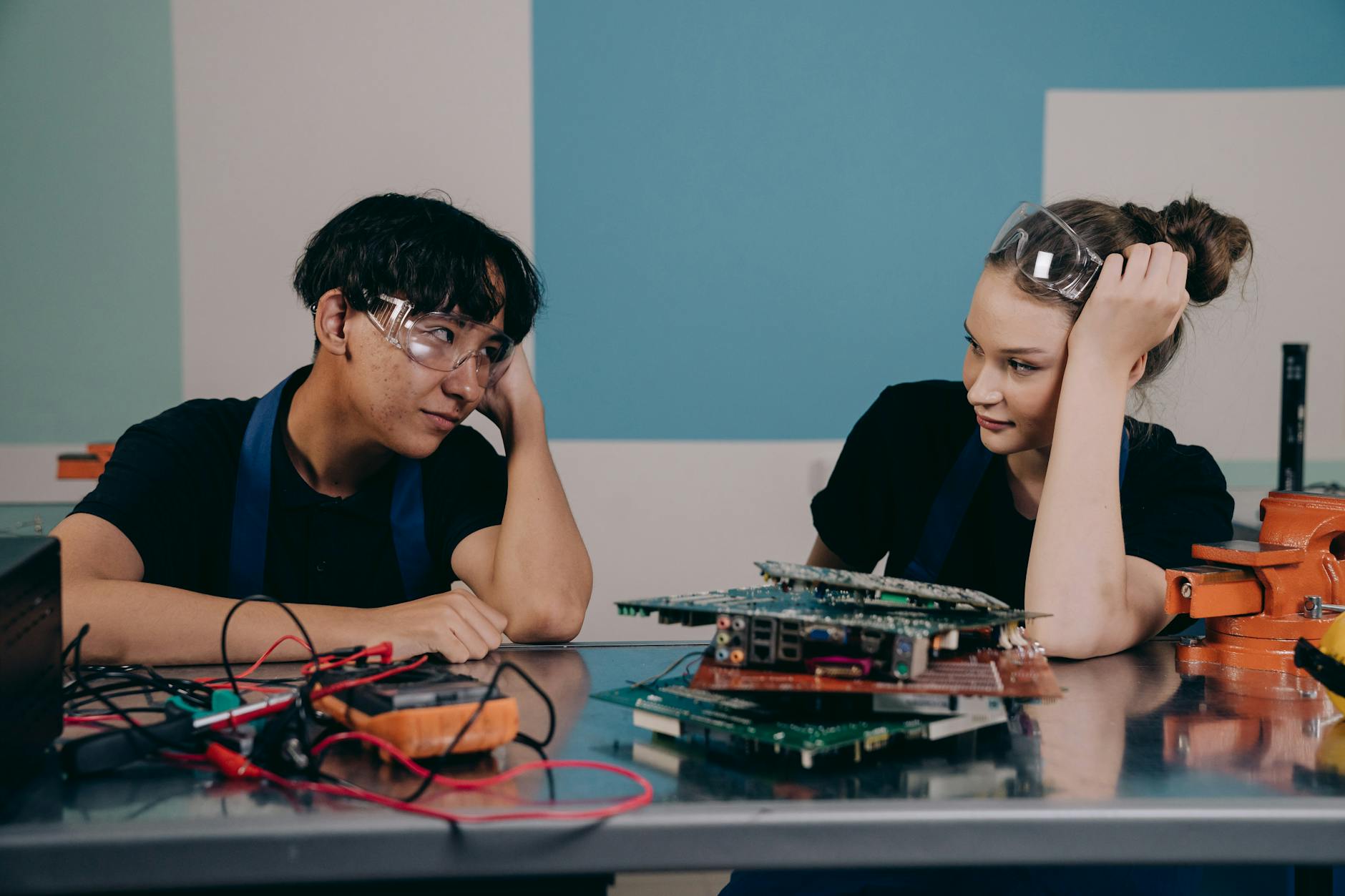
What do you do in a physics lab?
You follow an experimental procedure, record measurements with units, perform calculations, and decide whether the results support a prediction. You also consider uncertainty: measurements are never perfectly precise, and experimental conditions can affect the outcome.
For example, a motion experiment might ask you to record positions at different times and use a graph to understand how an object moves. Your conclusion should explain what the data show, not just whether the experiment produced the answer you expected.
What does a physics lab look like?
A physical lab may have benches, measuring instruments, ramps, timers, and electrical equipment. An online lab can show those tools on a screen instead: you interact with a simulated setup and collect data from virtual instruments.
The Physics Lab course uses eight browser-based simulations with calibrated virtual instruments. Each session generates its own specimen data set, so the report is based on that student's session. The syllabus below shows the activities and estimated hours for each part of the course.
| # | Chapter | Lessons | Hours |
|---|---|---|---|
| Lab 1 | Measurement, Significant Figures & Uncertainty | Reading: Lab-01_Student-Handout_and_Rubric.docx (student directions); Virtual lab sequence: Overview → Pre-Lab → Part A · Dimensions & Caliper → Part B · Mass → Part C · Glider Timing → Calculations → Post-Lab → Lab Report; Assignment: complete the simulation and submit the auto-compiled lab report, graded against the instructor rubric (final page of the same document) | 6 |
| Lab 2 | Vectors & Displacement Mapping | Reading: Lab-02_Student-Handout_and_Rubric.docx (student directions); Virtual lab sequence: Overview → Pre-Lab → Part A · Measure Segments → Part B · Components → Part C · Resultant → Calculations → Post-Lab → Lab Report; Assignment: complete the simulation and submit the auto-compiled lab report, graded against the instructor rubric (final page of the same document) | 6 |
| Lab 3 | Motion in One Dimension & Free Fall – Measuring g | Reading: Lab-03_Student-Handout_and_Rubric.docx (student directions); Virtual lab sequence: Overview → Pre-Lab → Part A · Position Data → Part B · Velocities → Part C · Graph & Slope → Calculations → Post-Lab → Lab Report; Assignment: complete the simulation and submit the auto-compiled lab report, graded against the instructor rubric (final page of the same document) | 6 |
| Lab 4 | Projectile Motion in Two Dimensions | Reading: Lab-04_Student-Handout_and_Rubric.docx (student directions); Virtual lab sequence: Overview → Pre-Lab → Part A · Launch & Height → Part B · Predict Landing → Part C · Launch & Test → Calculations → Post-Lab → Lab Report; Assignment: complete the simulation and submit the auto-compiled lab report, graded against the instructor rubric (final page of the same document) | 6 |
| Lab 5 | Newton's Laws & the Coefficient of Friction | Reading: Lab-05_Student-Handout_and_Rubric.docx (student directions); Virtual lab sequence: Overview → Pre-Lab → Part A · Slipping Angle → Part B · Spring Scale → Part C · Free-Body → Calculations → Post-Lab → Lab Report; Assignment: complete the simulation and submit the auto-compiled lab report, graded against the instructor rubric (final page of the same document) | 6 |
| Lab 6 | Work, Energy & Conservation on a Ramp | Reading: Lab-06_Student-Handout_and_Rubric.docx (student directions); Virtual lab sequence: Overview → Pre-Lab → Part A · Weigh & Measure → Part B · Release Trials → Part C · Energy Accounting → Calculations → Post-Lab → Lab Report; Assignment: complete the simulation and submit the auto-compiled lab report, graded against the instructor rubric (final page of the same document) | 6 |
| Lab 7 | Oscillations & Sound – Pendulum and Acoustic Resonance | Reading: Lab-07_Student-Handout_and_Rubric.docx (student directions); Virtual lab sequence: Overview → Pre-Lab → Part A · Pendulum → Part B · Resonance → Part C · Speed of Sound → Calculations → Post-Lab → Lab Report; Assignment: complete the simulation and submit the auto-compiled lab report, graded against the instructor rubric (final page of the same document) | 7 |
| Lab 8 | Fluids & Electric Circuits (Two-Part) | Reading: Lab-08_Student-Handout_and_Rubric.docx (student directions); Virtual lab sequence: Overview → Pre-Lab → Part A · Density & Buoyancy → Part B · Ohm's Law → Part C · Resistance & Power → Calculations → Post-Lab → Lab Report; Assignment: complete the simulation and submit the auto-compiled lab report, graded against the instructor rubric (final page of the same document) | 6 |
| Orientation, Lab Rules & Report-Format Training | Course platform | 1.5 | |
| Graded Quizzes (8 quizzes) | Course platform (Thinkific) | 4.5 |
A virtual experiment gives you practice collecting and interpreting data, but it is not the same experience as physically setting up equipment. For more on the format, see how an online physics lab works.
Which colleges have matched Physics Lab? 1 college confirms UPI Study's Physics Lab (PHYS 200L, 1 credits), according to its equivalency page on UPI Study. Here they are, with the course it counts as at each:
| College | Course it counts as | Credits | How it counts |
|---|---|---|---|
| University of the People | General Elective (UoPeople) | 1 | Transfers (Elective) |
See Physics Lab on UPI Study →
ACE and NCCRS have over 2,100 cooperating colleges that will consider accepting credits; the final decision is with the universities. Each college confirms the course when it evaluates your transcript.
What physics lab experiments do you do?
The eight PHYS 200L experiments cover the following topics:
- Measurement and uncertainty: Read a virtual caliper, measure mass, and time a glider. Report measurements with suitable units and precision.
- Vectors and displacement: Measure segments, resolve them into components, and find the resultant displacement.
- One-dimensional motion and free fall: Use position data, velocities, and a graph to investigate motion and measure gravitational acceleration.
- Projectile motion: Use launch and height measurements to predict a landing position, then test the prediction.
- Newton's laws and friction: Investigate a slipping angle and spring-scale readings, then use a free-body diagram to analyze forces.
- Work and energy: Measure a ramp setup, run release trials, and account for changes in energy.
- Oscillations and sound: Investigate a pendulum and acoustic resonance, including a calculation of the speed of sound.
- Fluids and circuits: Examine density and buoyancy, then use circuit data to explore Ohm's law, resistance, and power.
For background on why experimental measurements matter, read classic physics experiments explained.
The Complete Resource for Physics Lab
UPI Study has a full resource page built specifically for physics lab — covering which courses count and how to get started at $250 per course with no deadlines. Your college decides how credits transfer.
See the Physics Lab course →How does an online physics lab work?
Each lab starts with a student handout and directions, followed by a virtual sequence that includes an overview, pre-lab, experimental parts, calculations, and a post-lab. You complete the simulation at your own pace and export the auto-compiled report for submission.
There are eight reports and eight graded quizzes. You take each 10-question quiz after submitting the corresponding report. Reports count for 70% of the overall grade and quizzes for 30%; the stated passing rule is a score of 70 or above. Missing a required component may result in failure.
How do you write a physics lab report?
A physics lab report explains what you investigated, how you collected data, what you calculated, and what the results mean. Use the lab's directions and rubric to determine the required format; include units, appropriate significant figures, and an explanation of relevant uncertainty.
For example, if your measured result differs from a prediction, discuss plausible sources of error and how they could affect the result. Avoid calling a result wrong solely because it differs: compare the difference with the uncertainty when the information is available.
The simulations compile the reports for export, but the course requires clear presentation of data, calculations, and conclusions. See how to write a physics lab report for more guidance.
Which colleges list Physics Lab on an equivalency chart?
These colleges show Physics Lab (PHYS 200L) on their equivalency charts with UPI Study. Open a college for its full chart.
| College | Equivalent course | Credits | Status |
|---|---|---|---|
| UoPeople | General Elective (UoPeople) | 1 | Elective credit |
| CSU | Open Electives | 1 | Recommended by UPI Study — the college confirms on evaluation |
| Crestpoint | General Elective (Crestpoint) | 1 | Recommended by UPI Study — the college confirms on evaluation |
| Dunlap-Stone | General Education Science | 1 | Recommended by UPI Study — the college confirms on evaluation |
| Gracelyn | General education: Broad Knowledge and Intellectual Skills (Sciences) | 1 | Recommended by UPI Study — the college confirms on evaluation |
| Indiana Tech | PH 1310 – General Physics I Laboratory | 1 | Recommended by UPI Study — the college confirms on evaluation |
| Maestro | UPI Recommended | 1 | Recommended by UPI Study — the college confirms on evaluation |
| Newlane | Scientific Reasoning GE | 1 | Recommended by UPI Study — the college confirms on evaluation |
See the rest of the equivalency on the Physics Lab course page, or open a college above for its full chart. ACE and NCCRS have over 2,100 cooperating colleges that will consider accepting credits; the final decision is with the universities.
Frequently Asked Questions about Physics Lab
Physics lab can be challenging if you are new to measurements, graphs, or algebra, but it also gives you a way to practice those skills. Reading the directions before each experiment and checking units as you calculate can make the work more manageable.
Yes, some physics labs are available online through simulations. PHYS 200L uses browser-based virtual instruments rather than physical equipment, so check whether that format meets your program's requirement.
A physics lab manual is a set of instructions and guidance for laboratory activities. It can explain the procedure, measurements, calculations, and reporting expectations; follow the materials provided for your specific lab.
College physics courses can include a lab or have a separate lab component, but requirements depend on the course and program. Check your degree plan and course descriptions to see what you need.
A lab coat is not necessarily required for every physics lab. Clothing and protective equipment depend on the activity and the institution's safety rules, so check the instructions before attending an in-person session.
Physics lab requirements vary by medical school. Check each school's current admission requirements, including whether it accepts online labs, before choosing a course.
Some schools may accept an online physics lab, while others may have different requirements. Ask each medical school you are considering about its current policy and your particular course before enrolling.
Use the format and rubric supplied for your lab. A report generally needs a clear account of the investigation, data with units, calculations, results, and a conclusion that addresses uncertainty.
Final Thoughts on Physics Lab
Start by checking your program's lab requirement, especially whether it accepts a virtual format. Then review the experiment list and report expectations to see whether the course fits what you need to learn.
The way this actually clicks
Skip step 3 and the whole thing is wasted.
Ready to Earn College Credit?
Credit recommended by NCCRS · Self-paced · Your college decides how credits transfer · $150/course or $99/month (US)
Comments
No comments yet. Ask a question or share how it went for you.