
Chemistry lab can be challenging, but careful preparation and practice make it manageable for many students. The hard part is often doing several things at once: following directions, collecting reliable data, using calculations, and explaining your results. This guide breaks down each step and shows you how to prepare.
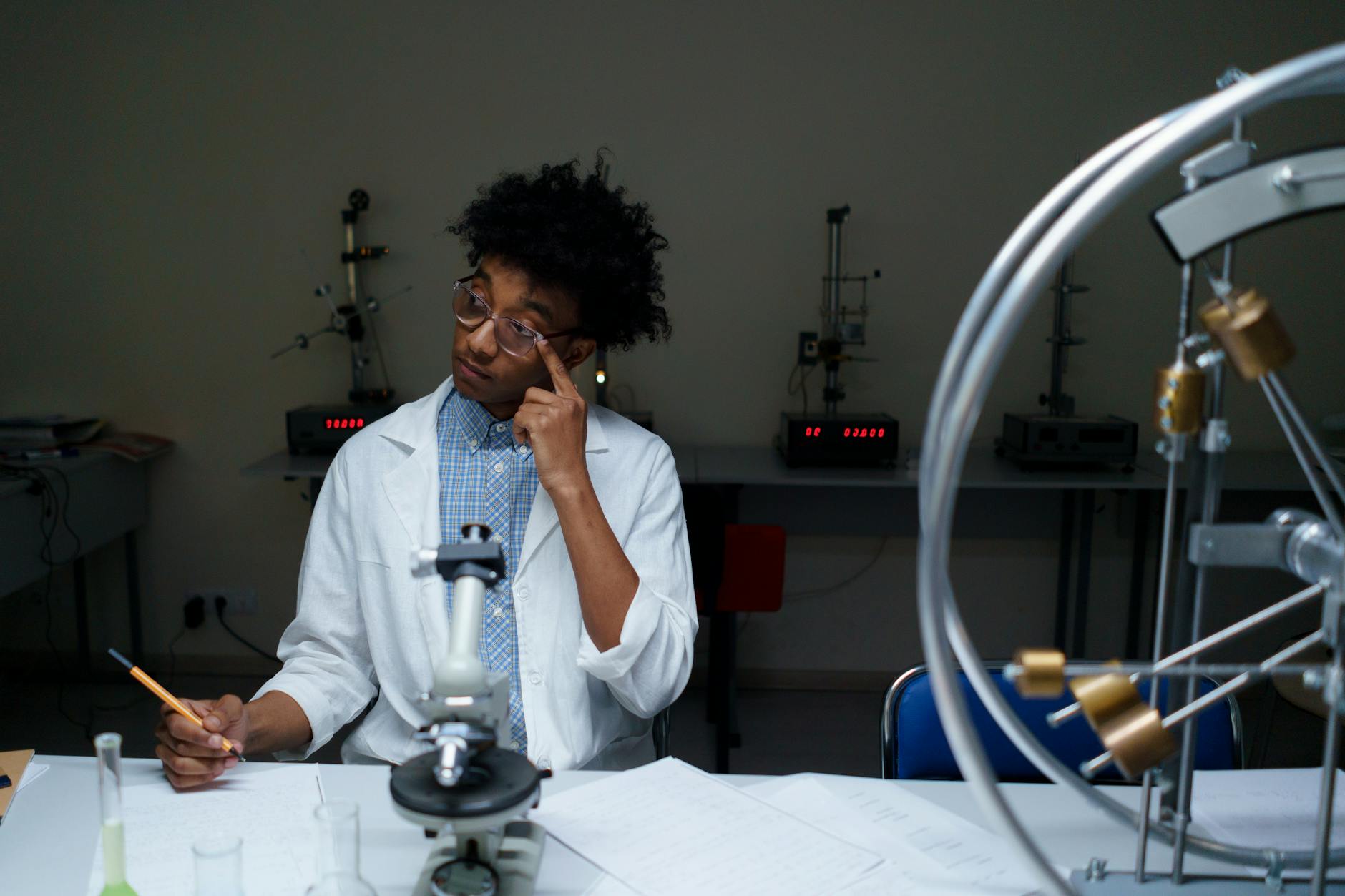
Is Chemistry Lab Hard?
Chemistry lab can be difficult because it combines concepts with procedures and written explanations. You might understand an equation in class but still need practice deciding which measurements to use and what the result means.
Common challenges include keeping track of units, following a procedure in order, interpreting unexpected results, and finishing a report. The difficulty depends on your background, the experiment, and how the course is taught. If your math or chemistry skills feel rusty, review the relevant concepts before each lab rather than trying to relearn everything at once.
What Does Chemistry Lab Include?
A general chemistry lab commonly asks you to prepare for an experiment, collect observations or measurements, perform calculations, and explain your findings. Topics may include density, the mole, heat changes, separation techniques, and acid–base reactions.
For example, suppose a sample has a mass of 12.0 g and a volume of 4.00 mL. Its density is mass divided by volume: 12.0 g ÷ 4.00 mL = 3.00 g/mL. A report might also ask you to explain how measurement uncertainty could affect that result.
In a physical lab, knowing what tools measure is useful before you begin. This guide to chemistry lab equipment can help you review common apparatus.
Which colleges have matched Chemistry Lab? 2 colleges confirm UPI Study's Chemistry Lab (CHEM 111L, 1 credits), according to their equivalency pages on UPI Study. Here they are, with the course it counts as at each:
| College | Course it counts as | Credits | How it counts |
|---|---|---|---|
| Thomas Edison State University | CHE-1280 General Chemistry I Lab | 1 | Transfers |
| University of the People | General Elective (UoPeople) | 1 | Transfers (Elective) |
See Chemistry Lab on UPI Study →
ACE and NCCRS have over 2,100 cooperating colleges that will consider accepting credits; the final decision is with the universities. Each college confirms the course when it evaluates your transcript.
How Do You Work in a Chemistry Lab?
A repeatable routine helps you focus on the experiment instead of scrambling to understand each step as you go.
- Read the procedure and identify its purpose, hazards, and required calculations.
- Complete any pre-lab work and prepare a place to record measurements with units.
- Follow the directions in order. Ask your instructor if a step or safety instruction is unclear.
- Record observations and data as they happen, even if the results are unexpected.
- Check calculations, units, and the report instructions before submitting your work.
If an experiment involves moles, practice converting between grams and moles using molar mass beforehand. If it involves a titration, review what the equivalence point means and how it relates to the reaction.
The Complete Resource for Chemistry Lab
UPI Study has a full resource page built specifically for chemistry lab — covering which courses count and how to get started at $250 per course with no deadlines. Your college decides how credits transfer.
See Chemistry Lab →What Not to Do in Chemistry Lab?
Do not eat, drink, taste chemicals, work without required protective equipment, or perform unassigned experiments. Never mix chemicals or dispose of materials unless the procedure or instructor tells you how. Do not change recorded data to make an experiment look successful.
Before working in a physical lab, learn the locations of the eyewash, safety shower, exits, and other emergency equipment your instructor identifies. The most important item depends on the hazard and situation; there is no single location that replaces knowing the lab’s emergency procedures. Report spills, injuries, or broken equipment promptly and follow your instructor’s directions.
How Do You Write a Chemistry Lab Report?
A chemistry lab report explains what you investigated, what you did, what you observed, and what your results mean. Follow your instructor’s format and rubric first: required sections and levels of detail can differ.
A typical report includes a purpose, a brief description of the method, data with units, sample calculations, results, and a conclusion. In the discussion, connect the results to the chemistry and identify plausible sources of error. For instance, a misread liquid volume could affect a calculated density; explain the possible effect rather than simply saying “human error.”
For a closer look at organizing each section, read how to write a chemistry lab report.
How Does an Online Chemistry Lab Work?
An online chemistry lab may use simulations to guide you through procedures, generate observations, and provide data for calculations. You still need to interpret the results and complete the assigned work, although the experience of handling physical equipment differs from an in-person lab.
Before choosing a course, ask your college whether a virtual lab meets the specific requirement for your degree or intended program. Also check whether you need a separate lecture course.
For one example of a self-paced format, see UPI Study’s Chemistry Lab course. The table summarizes its course details and assessment requirements.
| Chemistry Lab | Detail |
|---|---|
| Course code | CHEM 111L |
| College credits | 1 semester credits |
| Credit recommended by | NCCRS |
| Format | Self-paced, online, on UPI Study's platform |
| Chapters | 8 chapters, 60 study hours in the syllabus |
| To pass | A score of 70 or above (NCCRS requirement) |
| Price (one course, lifetime access) | $250 |
| US plans (all courses) | $99/month · $279/4 months · $495/year · $599 lifetime |
For more on simulations and typical assignments, see how an online chemistry lab works.
Which colleges list Chemistry Lab on an equivalency chart?
These colleges show Chemistry Lab (CHEM 111L) on their equivalency charts with UPI Study. Open a college for its full chart.
| College | Equivalent course | Credits | Status |
|---|---|---|---|
| TESU | CHE-1280 General Chemistry I Lab | 1 | Confirmed on the college's chart |
| UoPeople | General Elective (UoPeople) | 1 | Elective credit |
| CSU | Open Electives | 1 | Recommended by UPI Study — the college confirms on evaluation |
| Crestpoint | Chemistry (with Labs) | 1 | Recommended by UPI Study — the college confirms on evaluation |
| Dunlap-Stone | General Education Science | 1 | Recommended by UPI Study — the college confirms on evaluation |
| Gracelyn | General education: Broad Knowledge and Intellectual Skills (Sciences) | 1 | Recommended by UPI Study — the college confirms on evaluation |
| Indiana Tech | CH 1225 – General Chemistry I Lab | 1 | Recommended by UPI Study — the college confirms on evaluation |
| Maestro | UPI Recommended | 1 | Recommended by UPI Study — the college confirms on evaluation |
See the rest of the equivalency on the Chemistry Lab course page, or open a college above for its full chart. ACE and NCCRS have over 2,100 cooperating colleges that will consider accepting credits; the final decision is with the universities.
Frequently Asked Questions about Chemistry Lab
Chem lab may feel easy once you are comfortable with the procedures and calculations, but that varies by student and experiment. Preparing before each session and reviewing feedback can make unfamiliar tasks more manageable.
Chemistry lab work is the practical investigation of chemical ideas through procedures, observations, measurements, and analysis. It often ends with calculations and a report explaining the results.
A virtual chemistry lab uses a digital environment to model experiments or laboratory procedures. Students may make observations, analyze data, and complete reports without handling physical chemicals.
A chemistry lab report is a written account of an investigation and its results. It typically includes the purpose, method, data, calculations, and a conclusion, although instructors may require a different format.
A chemistry lab manual is a collection of instructions and other materials for lab activities. It may include procedures, safety information, background concepts, and questions to complete before or after an experiment.
Chemistry lab equipment includes the tools used to measure, contain, heat, or handle materials during an experiment. Examples include balances, graduated cylinders, beakers, and thermometers.
Requirements vary by medical school, so check the current admissions requirements for each school you are considering. Ask whether its chemistry requirement includes a lab and whether it accepts online or virtual lab coursework.
Online chemistry lab classes can use simulations, guided activities, reports, and quizzes to teach and assess lab concepts. The exact activities and whether physical equipment is involved depend on the course.
Final Thoughts on Chemistry Lab
Before your next lab, read the procedure, identify the calculation you will need, and make a plan for recording data. If you are considering an online lab, ask your college how it would apply to your specific program before enrolling.
The way this actually clicks
Skip step 3 and the whole thing is wasted.
Ready to Earn College Credit?
Credit recommended by NCCRS · Self-paced · Your college decides how credits transfer · $150/course or $99/month (US)
Comments
No comments yet. Ask a question or share how it went for you.