
In a college chemistry lab, you follow procedures, make observations, collect measurements, calculate results, and explain what those results mean. You also learn lab safety and report your findings.
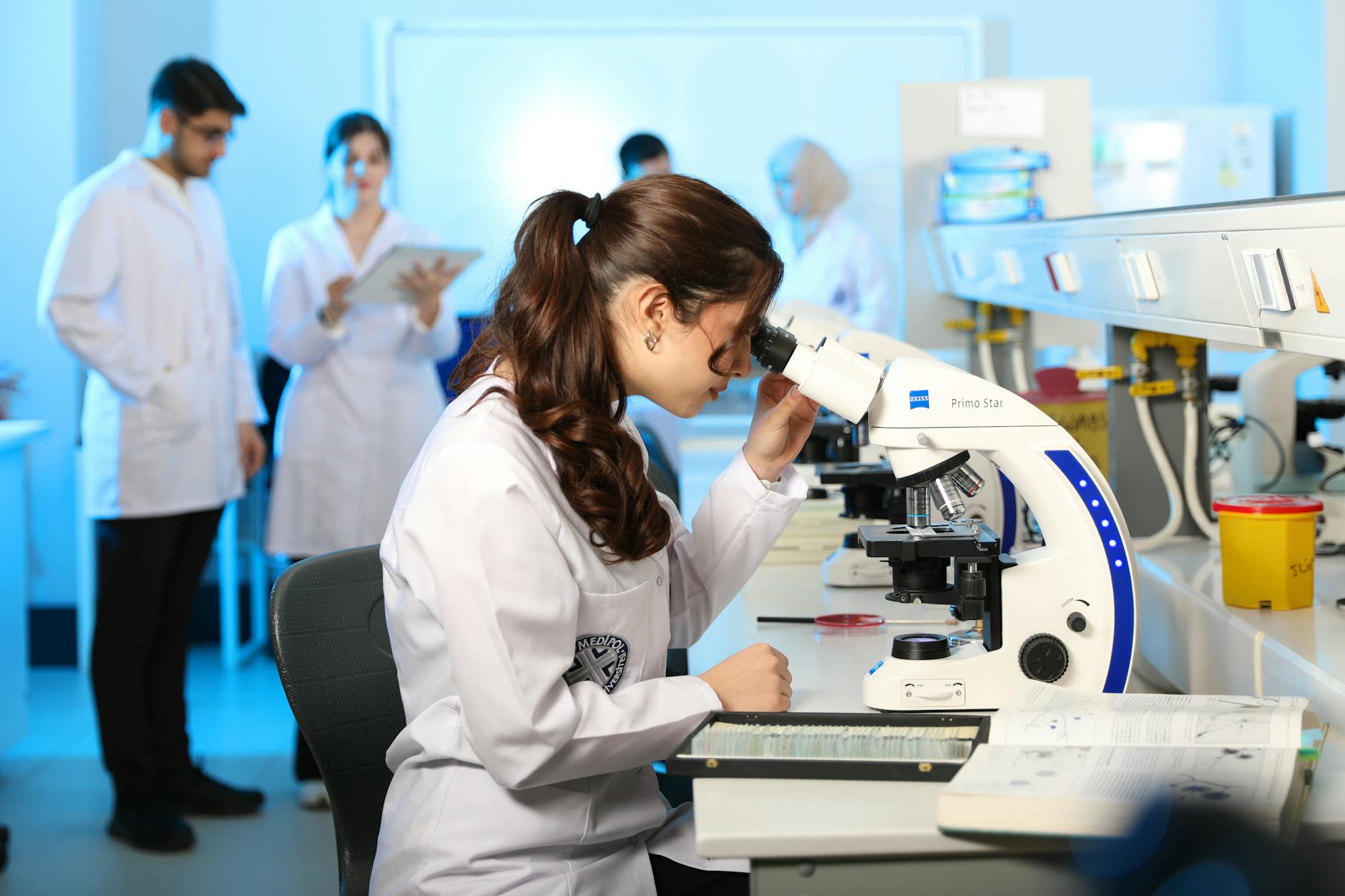
What is chemistry lab work?
Chemistry lab work is the practical investigation of chemical ideas. Depending on the course, you might measure a sample, observe a reaction, separate a mixture, or use data to identify an unknown substance.
The work does not end when the experiment does. You also organize data, perform calculations, consider whether the results make sense, and explain sources of uncertainty. A virtual lab uses a simulation for the experimental activity rather than asking you to manipulate physical materials.
What does chemistry lab include?
These six CHEM 111L experiments introduce different ways chemists gather and interpret evidence:
- Mass, volume, and density: Measure mass and determine volume using dimensions or displacement. Calculate density as mass divided by volume, then use the result to help identify an unknown.
- Avogadro’s number and the mole: Work with counting, molar mass, and samples to connect the mass of a substance with the number of particles it contains.
- Empirical formula of zinc chloride: Weigh zinc, follow a reaction and evaporation sequence, and use mass data to determine the simplest whole-number ratio of elements in the compound.
- Calorimetry: Examine heat changes involving calcium chloride and ammonium nitrate. Use measurements to calculate heat flow and consider heat loss.
- Chromatography: Separate components of a mixture and compare their Rf values with known values to help identify an unknown. Rf is the distance a component travels divided by the distance traveled by the solvent front.
- Titration curves using a pH probe: Examine pH data for hydrochloric acid and acetic acid, interpret titration curves, and determine pKa and concentrations from the data.
For a closer look at the tools used in physical labs, see the chemistry lab equipment guide.
Which colleges have matched Chemistry Lab? 2 colleges confirm UPI Study's Chemistry Lab (CHEM 111L, 1 credits), according to their equivalency pages on UPI Study. Here they are, with the course it counts as at each:
| College | Course it counts as | Credits | How it counts |
|---|---|---|---|
| Thomas Edison State University | CHE-1280 General Chemistry I Lab | 1 | Transfers |
| University of the People | General Elective (UoPeople) | 1 | Transfers (Elective) |
See Chemistry Lab on UPI Study →
ACE and NCCRS have over 2,100 cooperating colleges that will consider accepting credits; the final decision is with the universities. Each college confirms the course when it evaluates your transcript.
How does an online chemistry lab work?
An online lab can guide you through a simulated experiment, from a pre-lab activity through data analysis and a report. It lets you practice interpreting experimental results, although using a simulation is different from handling equipment in person.
The table summarizes the Chemistry Lab course offered by UPI Study.
| Chemistry Lab | Detail |
|---|---|
| Course code | CHEM 111L |
| College credits | 1 semester credits |
| Credit recommended by | NCCRS |
| Format | Self-paced, online, on UPI Study's platform |
| Chapters | 8 chapters, 60 study hours in the syllabus |
| To pass | A score of 70 or above (NCCRS requirement) |
| Price (one course, lifetime access) | $250 |
| US plans (all courses) | $99/month · $279/4 months · $495/year · $599 lifetime |
For each of the six labs, students read the directions, complete a virtual sequence, and submit the report exported from the simulation. A graded quiz follows each submitted report. Reports account for 70% of the overall grade and quizzes for 30%; missing a required component may result in failure of the class.
For more detail about the virtual format, read how an online chemistry lab works.
The Complete Resource for Chemistry Lab
UPI Study has a full resource page built specifically for chemistry lab — covering which courses count and how to get started at $250 per course with no deadlines. Your college decides how credits transfer.
See Chemistry Lab →How do you write a chemistry lab report?
A chemistry lab report explains what you investigated, what you observed, and what your results mean. Follow the instructions and rubric for your particular lab rather than assuming every course uses the same format.
Typically, a report presents the purpose and method, recorded data, calculations, results, and a conclusion. Explain possible sources of error and how they could affect your result; do not change data to make an answer look better.
For a more detailed walkthrough, see how to write a chemistry lab report.
What should you not do in a chemistry lab?
Do not begin an in-person experiment before reading the procedure and understanding the safety instructions. Never taste chemicals, eat or drink at the bench, or mix substances outside the assigned procedure.
Wear the protective equipment your instructor specifies, and know how to report a spill or injury. Before starting, locate relevant emergency equipment, such as the eyewash station, safety shower, and exits; the most urgent equipment depends on the hazards and the situation.
Is chemistry lab hard?
Chemistry lab can be challenging if you are new to unit conversions, careful measurement, or explaining calculations. It becomes more manageable when you prepare before each experiment and record observations as you go.
For example, if a sample has a mass of 12 grams and a volume of 4 milliliters, its density is 3 grams per milliliter. Practicing calculations like this—and checking units—can help you focus on interpreting results.
Which colleges list Chemistry Lab on an equivalency chart?
These colleges show Chemistry Lab (CHEM 111L) on their equivalency charts with UPI Study. Open a college for its full chart.
| College | Equivalent course | Credits | Status |
|---|---|---|---|
| TESU | CHE-1280 General Chemistry I Lab | 1 | Confirmed on the college's chart |
| UoPeople | General Elective (UoPeople) | 1 | Elective credit |
| CSU | Open Electives | 1 | Recommended by UPI Study — the college confirms on evaluation |
| Crestpoint | Chemistry (with Labs) | 1 | Recommended by UPI Study — the college confirms on evaluation |
| Dunlap-Stone | General Education Science | 1 | Recommended by UPI Study — the college confirms on evaluation |
| Gracelyn | General education: Broad Knowledge and Intellectual Skills (Sciences) | 1 | Recommended by UPI Study — the college confirms on evaluation |
| Indiana Tech | CH 1225 – General Chemistry I Lab | 1 | Recommended by UPI Study — the college confirms on evaluation |
| Maestro | UPI Recommended | 1 | Recommended by UPI Study — the college confirms on evaluation |
See the rest of the equivalency on the Chemistry Lab course page, or open a college above for its full chart. ACE and NCCRS have over 2,100 cooperating colleges that will consider accepting credits; the final decision is with the universities.
Frequently Asked Questions about Chemistry Lab
A virtual chemistry lab is a simulated environment for exploring experiments and analyzing results. It can help students practice scientific reasoning, but it is not the same as physically handling chemicals or equipment.
You follow an experimental procedure, collect observations or measurements, and analyze the results. You may also complete a report explaining your calculations and conclusions.
A chemistry lab report is a written account of an investigation and its findings. It usually includes data, calculations, and an explanation of the results.
A chemistry lab manual is a set of instructions and supporting information for lab activities. It may include procedures, safety guidance, and questions to answer before or after an experiment.
Chemistry lab equipment includes tools used to measure, contain, heat, or analyze substances. Examples include balances, graduated cylinders, beakers, and pH probes.
Online chemistry labs may use simulations to guide students through experimental steps and data analysis. In CHEM 111L, each virtual lab is followed by a report submission and a quiz.
It can be challenging, especially when an experiment combines unfamiliar procedures with calculations. Preparing ahead, tracking units, and reviewing the report instructions can help.
Students should know the locations of emergency equipment and exits before starting work. The most important item in a particular emergency depends on the hazard—for example, an eyewash station matters if a chemical gets into someone’s eyes.
Final Thoughts on Chemistry Lab
Start by reviewing the six experiment topics and identifying any calculations you want to practice. If you need a lab for a degree requirement, ask your college whether a virtual lab meets that specific requirement before enrolling.
The way this actually clicks
Skip step 3 and the whole thing is wasted.
Ready to Earn College Credit?
Credit recommended by NCCRS · Self-paced · Your college decides how credits transfer · $150/course or $99/month (US)
Comments
No comments yet. Ask a question or share how it went for you.