
A pH probe shows how a solution’s pH changes as titrant is added, producing the data for a titration curve. The curve helps you find the equivalence point and, for some weak acids, estimate pKa. In a titration lab, the important skill is connecting the shape of the graph to what is happening in the solution. You also need accurate volume readings and enough measurements near the steep part of the curve.
What is a virtual chemistry lab titration?
A virtual titration simulates adding a solution of known concentration, called the titrant, to a sample and recording the resulting pH. The measurements can be plotted as a titration curve: titrant volume goes on the horizontal axis, and pH goes on the vertical axis.
When a base is added to an acid, the curve generally rises. It may rise gradually at first, then sharply near the equivalence point, before leveling off as excess base determines the pH. The curve’s shape depends on the acid and base involved.
The Chemistry Lab course includes a virtual titration lab alongside other guided activities. The table shows the first six labs in the UPI Study syllabus.
| # | Chapter | Lessons | Hours |
|---|---|---|---|
| Lab 1 | Mass, Volume, and Density | Reading: Lab-01_Student-Handout_and_Rubric.docx (student directions); Virtual lab sequence: Overview → Pre-Lab → Part A · Mass → Part B · Dimensions → Part C · Displacement → Calculations → Identify Unknown → Post-Lab → Lab Report; Assignment: complete the simulation and submit the auto-compiled lab report, graded against the instructor rubric (final page of the same document) | 9 |
| Lab 2 | Avogadro's Number and the Mole | Reading: Lab-02_Student-Handout_and_Rubric.docx (student directions); Virtual lab sequence: Overview → Pre-Lab → Part A · Counting → Part B · Molar Mass → Part C · Samples → Part D · Water → Calculations → Post-Lab → Lab Report; Assignment: complete the simulation and submit the auto-compiled lab report, graded against the instructor rubric (final page of the same document) | 9 |
| Lab 3 | Empirical Formula of Zinc Chloride | Reading: Lab-03_Student-Handout_and_Rubric.docx (student directions); Virtual lab sequence: Overview → Pre-Lab → Part A · Weigh Zinc → Part B · Reaction → Part C · Evaporate → Empirical Formula → Definite Proportions → Post-Lab → Lab Report; Assignment: complete the simulation and submit the auto-compiled lab report, graded against the instructor rubric (final page of the same document) | 9 |
| Lab 4 | Calorimetry | Reading: Lab-04_Student-Handout_and_Rubric.docx (student directions); Virtual lab sequence: Overview → Pre-Lab → Part A · Setup → Part B · CaCl₂ → Part C · NH₄NO₃ → Heat Calculations → ΔH & Heat Loss → Post-Lab → Lab Report; Assignment: complete the simulation and submit the auto-compiled lab report, graded against the instructor rubric (final page of the same document) | 9 |
| Lab 5 | Chromatography | Reading: Lab-05_Student-Handout_and_Rubric.docx (student directions); Virtual lab sequence: Overview → Pre-Lab → Part A · Develop → Part B · Known Rf → Part C · Unknown → Identify → Polarity → Post-Lab → Lab Report; Assignment: complete the simulation and submit the auto-compiled lab report, graded against the instructor rubric (final page of the same document) | 9 |
| Lab 6 | Titration Curves Using a pH Probe | Reading: Lab-06_Student-Handout_and_Rubric.docx (student directions); Virtual lab sequence: Overview → Pre-Lab → Part A · HCl → Part B · CH₃COOH → Part C · pKa → Concentrations → Interpretation → Post-Lab → Lab Report; Assignment: complete the simulation and submit the auto-compiled lab report, graded against the instructor rubric (final page of the same document) | 10 |
What is chemistry lab equipment for a titration?
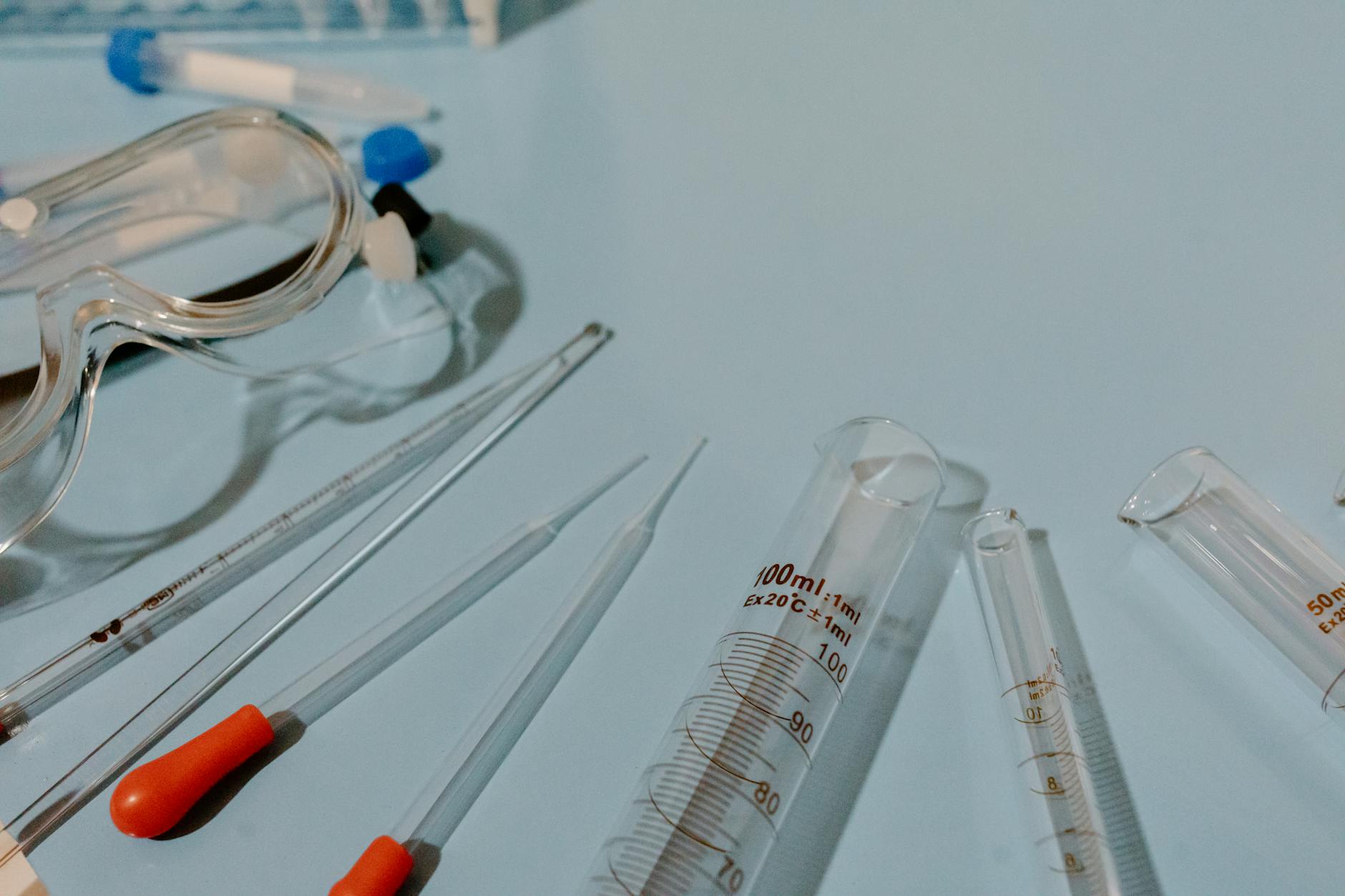
A pH probe measures the solution’s pH throughout the titration. A burette delivers measured volumes of titrant, while a beaker or flask holds the sample; stirring helps keep the solution mixed before each reading.
Before collecting data, calibrate the probe according to the instrument instructions. Rinse it between solutions, keep its sensing tip immersed, and allow the reading to stabilize. Record both the pH and the total volume of titrant added at each measurement.
For a closer look at common tools, see the chemistry lab equipment guide.
Which colleges have matched Chemistry Lab? 2 colleges confirm UPI Study's Chemistry Lab (CHEM 111L, 1 credits), according to their equivalency pages on UPI Study. Here they are, with the course it counts as at each:
| College | Course it counts as | Credits | How it counts |
|---|---|---|---|
| Thomas Edison State University | CHE-1280 General Chemistry I Lab | 1 | Transfers |
| University of the People | General Elective (UoPeople) | 1 | Transfers (Elective) |
See Chemistry Lab on UPI Study →
ACE and NCCRS have over 2,100 cooperating colleges that will consider accepting credits; the final decision is with the universities. Each college confirms the course when it evaluates your transcript.
How do you work in a chemistry lab to find the equivalence point?
The equivalence point occurs when the reactants have combined in the mole ratio required by the balanced equation. On a typical acid–base titration curve, it is near the middle of the steepest pH change, not necessarily at the first sharp rise.
For a strong acid titrated with a strong base, the equivalence-point pH is approximately 7 at 25°C. For a weak acid titrated with a strong base, it is above 7 because the weak acid’s conjugate base reacts with water. An indicator’s color-change endpoint is a practical signal; it may be close to, but is not necessarily identical to, the equivalence point.
To calculate an unknown concentration, use the equivalence volume and the balanced equation. For example, if 25.00 mL of a monoprotic acid requires 20.00 mL of 0.1000 M NaOH, the base supplies 0.02000 L × 0.1000 mol/L = 0.002000 mol. The acid has the same number of moles, so its concentration is 0.002000 mol ÷ 0.02500 L = 0.08000 M.
The Complete Resource for Chemistry Lab
UPI Study has a full resource page built specifically for chemistry lab — covering which courses count and how to get started at $250 per course with no deadlines. Your college decides how credits transfer.
See the Chemistry Lab course →What does chemistry lab work include when analyzing pKa?
For a weak acid titrated with a strong base, find the equivalence volume first, then locate half that volume on the graph. At the half-equivalence point, approximately equal amounts of the weak acid and its conjugate base are present, so the measured pH is an estimate of pKa.
For example, if equivalence occurs at 20.0 mL, read the pH at 10.0 mL. If that pH is 4.8, the estimated pKa is 4.8. This shortcut relies on the weak-acid titration conditions; it is not a way to find the pKa of a strong acid.
The acids and bases guide reviews weak acids and conjugate bases if those terms are unfamiliar.
How do you write a chemistry lab report for a titration?
Start with the purpose and a brief description of the procedure, then present the measurements and calculations so another reader can follow your reasoning. Follow your instructor’s required format and rubric.
- Include a table of total titrant volume and stabilized pH readings.
- Label both graph axes and their units, and mark the estimated equivalence point.
- Show the balanced equation and concentration calculation, including units.
- For a weak-acid titration, show how you estimated pKa at half-equivalence.
- Discuss uncertainty, such as overshooting the steep region or recording an unstable probe reading.
Use smaller titrant additions near the expected equivalence point to capture the steep change. A large addition can skip over the most useful part of the curve and make the equivalence volume harder to estimate.
Which colleges list Chemistry Lab on an equivalency chart?
These colleges show Chemistry Lab (CHEM 111L) on their equivalency charts with UPI Study. Open a college for its full chart.
| College | Equivalent course | Credits | Status |
|---|---|---|---|
| TESU | CHE-1280 General Chemistry I Lab | 1 | Confirmed on the college's chart |
| UoPeople | General Elective (UoPeople) | 1 | Elective credit |
| CSU | Open Electives | 1 | Recommended by UPI Study — the college confirms on evaluation |
| Crestpoint | Chemistry (with Labs) | 1 | Recommended by UPI Study — the college confirms on evaluation |
| Dunlap-Stone | General Education Science | 1 | Recommended by UPI Study — the college confirms on evaluation |
| Gracelyn | General education: Broad Knowledge and Intellectual Skills (Sciences) | 1 | Recommended by UPI Study — the college confirms on evaluation |
| Indiana Tech | CH 1225 – General Chemistry I Lab | 1 | Recommended by UPI Study — the college confirms on evaluation |
| Maestro | UPI Recommended | 1 | Recommended by UPI Study — the college confirms on evaluation |
See the rest of the equivalency on the Chemistry Lab course page, or open a college above for its full chart. ACE and NCCRS have over 2,100 cooperating colleges that will consider accepting credits; the final decision is with the universities.
Frequently Asked Questions about Chemistry Lab
A virtual chemistry lab is a digital environment for working through simulated experiments. Students can practice collecting and interpreting data without handling the physical materials.
Chemistry lab equipment consists of the tools used to measure, contain, mix, and analyze substances. In a titration, examples include a burette, a sample container, and a pH probe.
A chemistry lab report explains an experiment and its results. A titration report typically includes the procedure, data, graph, calculations, and discussion of uncertainty.
Format a chemistry lab report according to your instructor’s directions. Common sections include purpose, procedure, results, calculations, and conclusion, with clearly labeled tables and graphs.
Do not eat, taste chemicals, or ignore the lab’s safety instructions. Avoid adding titrant too quickly near equivalence, and do not record a pH reading before it has stabilized.
Chemistry lab can be challenging if measurements, calculations, or reports are unfamiliar. Practicing unit conversions and keeping organized records can make titration work easier to follow.
A chemistry lab manual provides directions and background for lab activities. It may also explain safety precautions, required measurements, and report expectations.
Chemistry lab work commonly includes following procedures, collecting measurements, analyzing results, and reporting conclusions. A titration lab adds tasks such as plotting pH against titrant volume and interpreting the curve.
Final Thoughts on Chemistry Lab
When reading a titration curve, identify the axes first, then estimate the equivalence volume from the steepest region. Use the balanced equation before calculating an unknown concentration, and use half-equivalence for pKa only when the weak-acid conditions apply.
The way this actually clicks
Skip step 3 and the whole thing is wasted.
Ready to Earn College Credit?
Credit recommended by NCCRS · Self-paced · Your college decides how credits transfer · $150/course or $99/month (US)
Comments
No comments yet. Ask a question or share how it went for you.